
TopicWell
Quench Your Curiosity – Find a New Favorite Holiday Today!
National Different Colored Eyes Day: Pet Edition
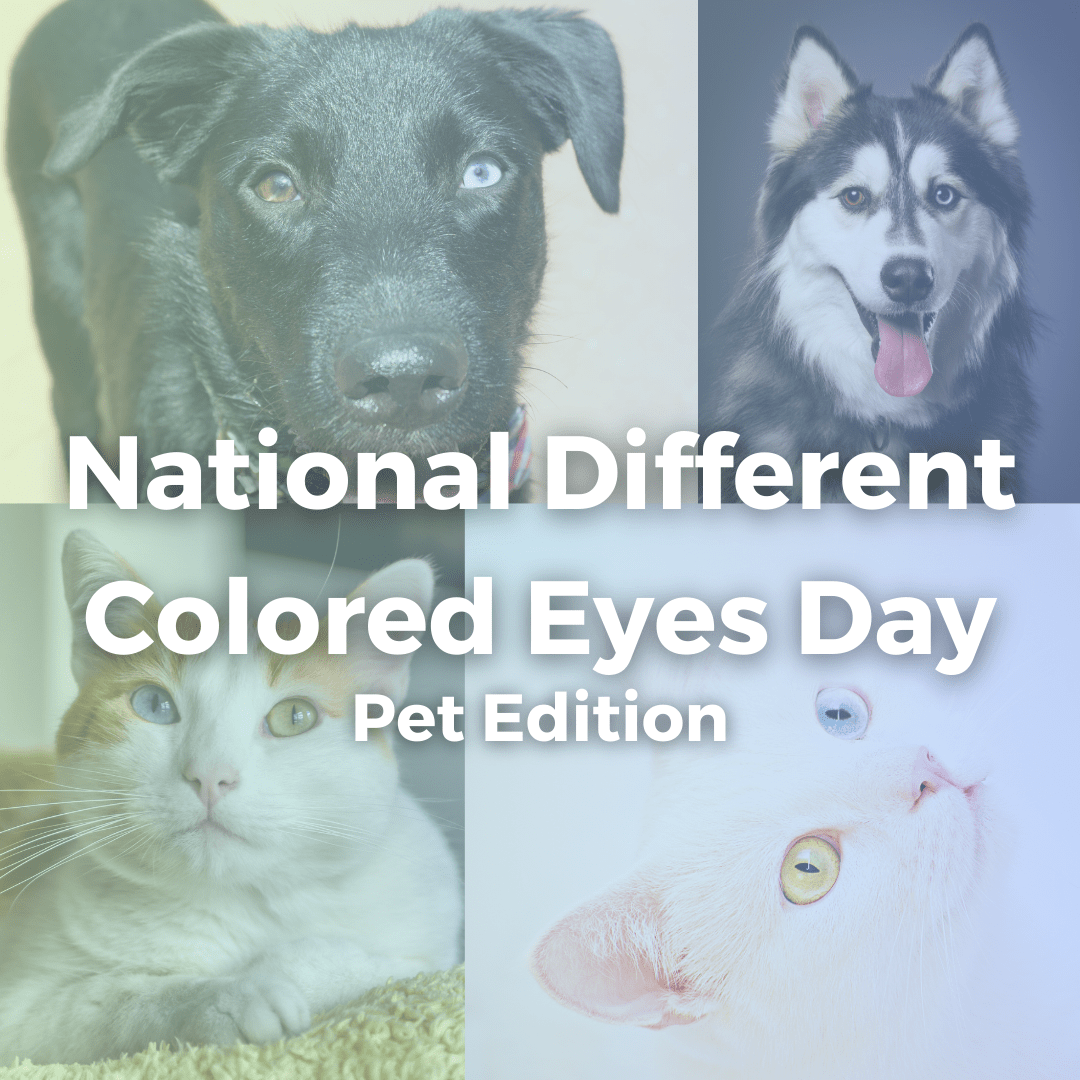
Many animals have unique eye colors, like the stunning blue-eyed husky. However, today on National Different Colored Eyes Day, July 12th, we’re celebrating those with heterochromia!
Heterochromia, or heterochromia iridum, is a fancy way of describing a person or animal with different colored eyes! Be it brown and blue or green and yellow, every spectrum of color is beautifully represented in the animal kingdom. Today, we’ll zero in on two endearing odd-eyed furballs: dogs and cats!
Meet Timmy and Katie!

Photo Credit: @lil_jes_128
Meet Timmy! When I told his human, Jes, about National Different Colored Eyes Day, he jumped at the opportunity to smile for the camera. He did not disappoint! This sweetheart is a fantastic example of a beautifully unique pet with heterochromia. He also illustrates the fact that white cats are the most likely felines to develop two uniquely colored eyes!

Photo Credit: Donald Freeman
Meet Katie! She is three parts Australian Shepherd, one part Collie, and all heart. She belongs to my (Liz’s) dad, and she is sweet as sugar. She enjoys playing outside, getting pets, and giving love! Katie represents two of the most common types of dogs to be born with heterochromia.
The Odds
Cats and dogs are more likely to develop heterochromia than one would think. While it is still rare, this genetic condition can be found in any breed. In humans, however, it is much less frequent.
The most common pet breeds to develop odd-eyes includes “British Shorthairs, Cornish and Devon Rex, Japanese Bobtails, Munchkins, Persians, Scottish Folds, Siamese, Sphynxes, Turkish Angoras and Turkish Vans” in cats and “Australian Cattle Dogs, Australian Shepherds, Border Collies, Chihuahuas, Dachshunds, Dalmatians, Great Danes, Shetland Sheepdogs, Siberian Huskies, and ShihTzus” in dogs, according to Lawndale Veterinary Hospital.
Misconceptions
Health is understandably a huge concern when it comes to your four-legged friends, but there’s little need to fret with your kitten or pup. Many believe that pets with heterochromia are more likely to develop health issues such as hearing loss, but this fear has not held up well over time. Always get your pet checked by a licensed veterinarian, but it is very likely your odd-eyed companion will live a substantial, happy life.
However, if you notice eye color changes, or acquired heterochromia, in an animal that previously had a single eye color, this could be a sign of an underlying issue. While heterochromia can develop after birth, it is normally seen when a puppy or kitten is between 9-12 weeks old. When in doubt, ask your vet!
Love on your odd-eyed pets today and enjoy celebrating National Different Colored Eyes Day!













 TopicWell
What a beautiful and unique post! I love learning about these amazing animals and their unique eye colors. Timmy and Katie are both gorgeous! It’s wonderful that we have a day dedicated to celebrating them. Thank you for sharing this with us, author!
LikeLike
What a great post! I absolutely adore Timmy and Katie! Seeing animals with heterochromia is truly something special. It is so amazing to see the different colors and spectrums that these animals possess. They are truly unique and beautiful creatures. It is very wonderful that National Different Colored Eyes Day is celebrated to honor these animals. Thank you for sharing this post and showing us the beauty of heterochromia! Thank you to the author for this lovely post!
LikeLiked by 1 person
Thank you very much! I’m glad you enjoyed our article. 🙂
LikeLike