
TopicWell
Quench Your Curiosity – Find a New Favorite Holiday Today!
National Different Colored Eyes Day: Pet Edition
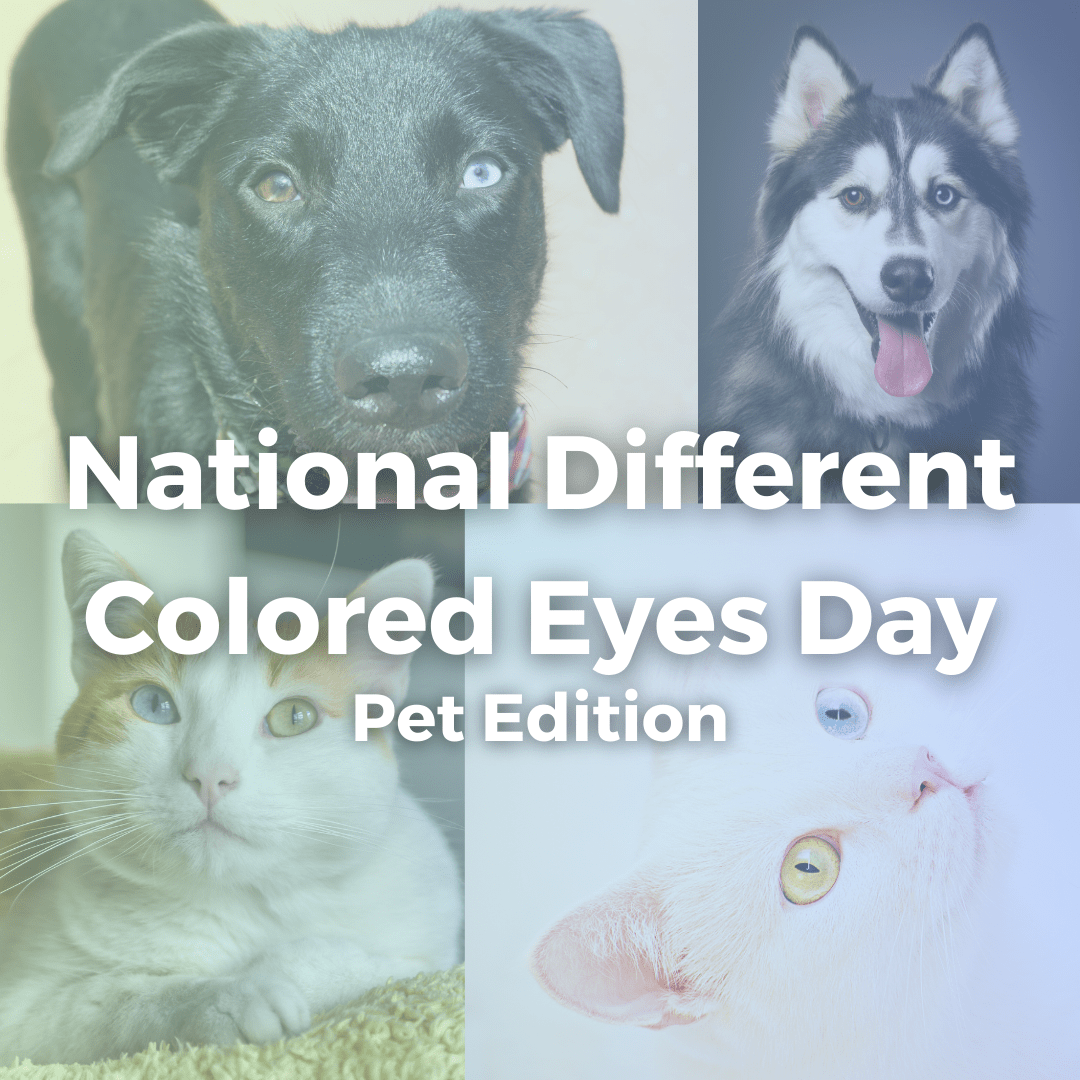
Many animals have unique eye colors, like the stunning blue-eyed husky. However, today on National Different Colored Eyes Day, July 12th, we’re celebrating those with heterochromia!
Heterochromia, or heterochromia iridum, is a fancy way of describing a person or animal with different colored eyes! Be it brown and blue or green and yellow, every spectrum of color is beautifully represented in the animal kingdom. Today, we’ll zero in on two endearing odd-eyed furballs: dogs and cats!
Meet Timmy and Katie!

Photo Credit: @lil_jes_128
Meet Timmy! When I told his human, Jes, about National Different Colored Eyes Day, he jumped at the opportunity to smile for the camera. He did not disappoint! This sweetheart is a fantastic example of a beautifully unique pet with heterochromia. He also illustrates the fact that white cats are the most likely felines to develop two uniquely colored eyes!

Photo Credit: Donald Freeman
Meet Katie! She is three parts Australian Shepherd, one part Collie, and all heart. She belongs to my (Liz’s) dad, and she is sweet as sugar. She enjoys playing outside, getting pets, and giving love! Katie represents two of the most common types of dogs to be born with heterochromia.
The Odds
Cats and dogs are more likely to develop heterochromia than one would think. While it is still rare, this genetic condition can be found in any breed. In humans, however, it is much less frequent.
The most common pet breeds to develop odd-eyes includes “British Shorthairs, Cornish and Devon Rex, Japanese Bobtails, Munchkins, Persians, Scottish Folds, Siamese, Sphynxes, Turkish Angoras and Turkish Vans” in cats and “Australian Cattle Dogs, Australian Shepherds, Border Collies, Chihuahuas, Dachshunds, Dalmatians, Great Danes, Shetland Sheepdogs, Siberian Huskies, and ShihTzus” in dogs, according to Lawndale Veterinary Hospital.
Misconceptions
Health is understandably a huge concern when it comes to your four-legged friends, but there’s little need to fret with your kitten or pup. Many believe that pets with heterochromia are more likely to develop health issues such as hearing loss, but this fear has not held up well over time. Always get your pet checked by a licensed veterinarian, but it is very likely your odd-eyed companion will live a substantial, happy life.
However, if you notice eye color changes, or acquired heterochromia, in an animal that previously had a single eye color, this could be a sign of an underlying issue. While heterochromia can develop after birth, it is normally seen when a puppy or kitten is between 9-12 weeks old. When in doubt, ask your vet!
Love on your odd-eyed pets today and enjoy celebrating National Different Colored Eyes Day!
National Different Colored Eyes Day
Happy National Different Colored Eyes Day!
Observed every July 12, we dedicate this day to celebrating the phenomenon that is heterochromia — specifically, heterochromia iridum. It’s a fun and meaningful way to appreciate the uniqueness of different colored eyes. Here are a few ways to help our heterochromia friends feel loved:
- Learn about heterochromia iridum! Unique as it is, some people may feel subconscious about their different colored eyes. Consider researching the causes, types, and its history.
- Spread awareness about today! Post facts, trivia, or personal stories involving heterochromia–just remember to get permission from loved ones if the stories involve them in any way. You could use hashtags like #DifferentColoredEyesDay, #Heterochromia, or #HeterochromiaIridum and join the conversations.
- Show appreciation for our different colored eyes friends! If you know someone with heterochromia, consider showing them extra love and appreciation today. Compliment their unique eye colors, spend time together, anything to show you care and appreciate them.
Remember, the goal of celebrating National Different Colored Eyes Day is to embrace and appreciate the beauty of diversity. Whether you have heterochromia yourself or simply want to support and acknowledge those who do, your participation can help create awareness and foster inclusivity.
The Facts
What is heterochromia iridum? It’s a variation of eye color in an individual. In most cases, that person has two different colored irises. This phenomenon allows them to have a blue left eye and brown right eye, or any other combination of colors. However, having two entirely different eye colors isn’t the only result.
There are three types of heterochromia a person can experience.
- Complete heterochromia: As described above, this appears as the eyes being different colors–one eye is blue, the other is brown.
- Sectoral heterochromia: Part of one iris has a different color or a distinct patch of a different color. This can result in a striking and unique appearance. For example, a brown iris could have a patch of green in it.
- Central heterochromia: The inner part of the iris has a different color compared to the outer part, leading to a ring or gradient effect. An example could involve gradients of blue, making it feel like you’re staring into the Peyto Lake in Alberta, Canada.
Causes for Heterochromia
According to the National Library of Medicine, people can inherit heterochromia. It can also occur spontaneously due to genetic changes. However, people can acquire different colored eyes beyond genetic factors, including:
- Developmental factors: Sometimes disruptions or abnormalities occur when the iris develops during fetal growth. These factors can lead to variations in pigment distribution or melanin concentration, resulting in different colored eyes.
- Eye trauma or injury: Later in life, heterochromia can develop due to damage. Changes in the blood vessels or structures in the eye can also alter eye color.
- Diseases or conditions: Eye diseases or conditions can cause heterochromia as a secondary effect. Examples include glaucoma, Horner’s syndrome, or uveitis. These conditions can affect the functioning of the iris or the production and distribution of eye pigments.
- Medications or treatments: Some medications or treatments, such as certain eye drops or medications used for glaucoma, may cause changes in eye color or contribute to heterochromia.
However, remember that not all heterochromia cases associate with underlying health issues. Some instances have proven different colored eyes as benign and purely cosmetic with no hint of medical significance.
If you or someone you know has concerns about eye color or changes in eye color, consider consulting with an eye care professional for a proper evaluation and diagnosis.
Heterochromia: A History
The exact time when people discovered heterochromia iridum remains a mystery. However, we know that our ancestors have observed and documented it since ancient times. Over the centuries, various cultures have mentioned people having different colored eyes, even depicting them in ancient artwork and literature.
Heterochromia has fascinated and intrigued people for centuries, especially because it appeared in people and animals. However, reactions to different colored eyes vary between cultures and time periods.
Here are some general insights into how people in the past may have reacted to heterochromia:
- Folklore and beliefs: Heterochromia often sparked myths, folklore, and superstitions in many cultures. Some believed it was a sign of special powers, mystical abilities, or divine connection. People have viewed them as unique or revered them due to their distinctive appearance.
- Symbolism and aesthetics: Sometimes, different colored eyes were associated with beauty, uniqueness, or rarity. Certain cultures considered them more attractive or captivating, often extending to artistic representations and depictions in literature with heterochromia portrayed as an intriguing and desirable trait.
- Stigma and discrimination: Some societies viewed heterochromia with stigma or discrimination due to perceived differences. Such views led to curiosity, prejudice, or even fear or suspicion. Such reactions depended on prevailing beliefs, cultural norms, and levels of understanding within communities.
Today, we appreciate heterochromia for its uniqueness and many consider it aesthetically appealing. However, individual experiences and cultural contexts may still vary.
Let’s Celebrate
National Different Colored Eyes Day is a remarkable time that invites us to celebrate and embrace the beauty of heterochromia. It’s a day to honor and appreciate individuals with captivating dual eye colors, a truly extraordinary trait.
Let’s celebrate the diversity of eye colors and extend our admiration to those with heterochromia. Join the festivities, spread awareness, and show your support. Embrace the magic of heterochromia and celebrate National Different Colored Eyes Day with joy and appreciation!
National Pecan Pie Day

Tomorrow, July 12th, is National Pecan Pie Day! Whether you pronounce it pee-can, puh-kaan, or another way, it’s hard to deny how widespread and loved the pecan pie is. Its popularity boomed in the 20th century from a marketing scheme for Karo corn syrup, and it has endured to this day. If you want to celebrate this sweet holiday, pick up a fork and dig into the decadent dessert with me!
How to Celebrate Pecan Pie Day
There’s no single way to celebrate this obscure but delicious holiday, but here are a few ideas!
- Bake or buy a pie for a loved one.
- Go pecan picking!
- Treat yourself to a slice of pie.
- Make a pie chart. You know, for fun.
- Have a friendly debate about the correct pronunciation of pecan.
Flick pecans at your sibling.- Experiment with new recipes!
What is a Pecan Pie?
Pecan pies have been around for a long time, from Southern kitchens to Karo corn syrup commercials. What are they made of, though? It depends on the regional variant, but the most popular makeup of a pecan pie includes a flour-based crust, pecans, corn syrup, sugar, eggs, and butter!
Pecan pies originated in the Southern United States, in either Texas or New Orleans. The jury is still out on which state got there first, but the dessert snowballed nationally with the introduction of the Karo pecan pie. It has since become a beloved holiday dish served around Thanksgiving and Christmas, but you can grab a slice any time of the year!

Learn how to make this pecan pie recipe here! Thank you, Betty Crocker!
Nontraditional Variations of the Pecan Pie
While most people stick to their guns and bake conventional pecan pie, there is a wide range of ways to add flair to the sugar-coma-inducing delicacy. One of the more popular renditions is the chocolate-pecan pie, which pairs a deep, rich cocoa flavor with crunchy pecans and a flaky crust. For those who like to add a splash of fun to their desserts, there’s the bourbon pecan pie. Last but not least, for a moist, sweet pie that falls apart on your tongue, you can try the coconut pecan pie. Whichever you choose, I hope you sit down with your new favorite pie and enjoy National Pecan Pie Day!

Chocolate-Pecan Pie
By Pillsbury

Southern Bourbon Pecan Pie
By Taste of Home
:max_bytes(150000):strip_icc():format(webp)/1072003-5baf9cddd0244699aa27f383d2ce443f.jpg)
Coconut Pecan Pie
By Allrecipes













 TopicWell